Samuel Wexler/Music/Resistance is Futile

Resistance is Futile

An experimental concept album: live violin at the center, AI electronica as the backdrop.

Live violin carries the story from start to finish, grounded by live djembe all the way through. The experiment is the backdrop: electronica generated with AI to frame the violin's story. The concept is a cyborg album, the fusion of man and machine, seen through the Borg of Star Trek.

Worth saying up frontResistance is Futile is the only work of mine with any AI elements whatsoever. Everything else I have made has none.

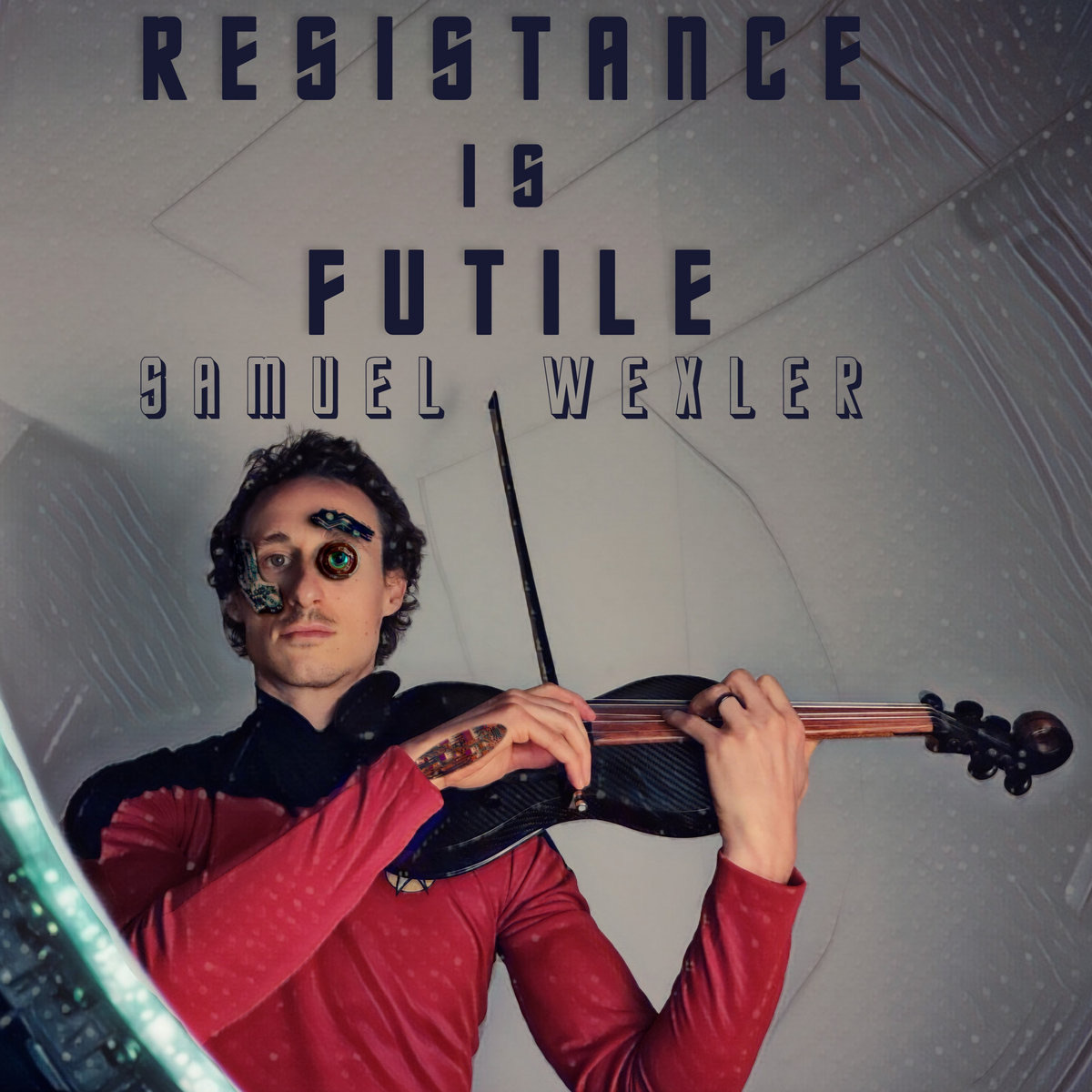
Resistance is Futile album cover. Samuel Wexler plays the violin in a red and black uniform, with a Borg style eyepiece over one eye.
15Tracks, released 30 August 2024
6Weeks to make, every spare minute
100%Of the profits donated to charity

Hear it

Fifteen tracks. Press play, and read on while it plays.

What you are hearing

The violin tells the story. The djembe anchors the groove. The AI is the backdrop.

"This would sound nice with a soulful violin part." I often think that when I hear electronic music. It has groove, but lacks soul.

ViolinLive. Lead lines, harmonies, solos and string arrangements.
Djembe and percussionLive. Djembe, shakers and rainstick, played by hand.
VoiceLive, where there is one. Every wordless voice on the album is mine.
ElectronicaGenerated with Udio, then cut, arranged and enhanced by me.
Played by a personGeneratedA sketch of one track, not a real session

AI let me generate a wide range of tracks, then inject them with a ton of live instrument soul, flipping them into a violin-centric album. There was no reason not to make it totally violin centered, since I was not covering up anyone's intricate, time intensive sound design.

Wherever a generated track had something like a wordless voice, I recorded my own voice over it, mixed the AI voice out, and often added harmonies of my own. I added instrumental intros and outros of my own too. And I left human idiosyncrasies in on purpose: the clank of a metal mic stand, my own voice, and the voice of my stepson, Joshua.

Can we embrace the new power of being cyborgs, without being predatorily assimilated by the Borg, nor becoming part of its collective?The question at the heart of the album

How it began

A friend asked if I had experimented with AI in my music. I said it was of no interest to me. Two months later, I released this album.

  1. Of no interest to me
  2. The dead of the night
  3. Resistance is futile
  4. Adapt or die

Of no interest to me

A few days before this album was even an idea, a friend asked if I had experimented with AI in my music. I said it was of no interest to me. I have spent years producing organically, I love the self discovery that comes from making music, and I am a classically trained violinist with a music degree.

But the seed was planted. I watched some videos and tried generating downtempo electronic tracks on Udio. At first I was relieved: some of them sucked. Then I was pretty amazed by some of what I heard, and my mind raced all day.

The dead of the night

To my huge surprise, I woke up in the dead of the night with the image of this album cover, the title and the concept in mind: live violin and djembe, with AI generated electronic music. I felt excitement and dread at the same time, and the uneasy feeling stayed with me for weeks.

I felt really uncomfortable and guilty about even considering using AI in my music, but I also felt I should see the vision through to completion.

Resistance is futile

When I discovered what AI music can do, I thought of what the Borg from Star Trek say: "You will be assimilated. Resistance is futile. Your distinctiveness will be added to our own."

The Borg assimilate the knowledge and technology of other species. AI music generators assimilate massive amounts of human made music, to create new music that sounds shockingly similar. So the whole album leans into the parallel, down to the track titles: The Collective, You Will Be Assimilated, Unimatrix Six, 7 of 15 Tertiary Adjunct, Species 5618, Your Musical Distinctiveness, and to close, Existence As You Know It Is Over.

Adapt or die

I can't say I felt comfortable using AI in my music. If I could choose to either have AI music exist or not, I'd honestly prefer not. But that is not the choice. It is adapt or die.

Obviously that is a dramatic way of saying it, and adapting does not necessarily mean making music with AI. But not adapting somehow could be a career ending mistake, and this seemed like a fun way to try to understand the new AI music phenomenon.

When a huge wave is coming, is it better to let it wreck you, or to ride it?

AI is more like a tsunami than a wave. Luckily, it is one we can collectively steer in a safe direction, if we get on it. So I made this album in about six weeks, with every spare minute, and a video series sharing what I learned along the way.

Fears and reasons

Nine fears. Seventeen reasons.

I had tons of fears about making this album, and tons of good reasons to do it. The fears came in three kinds: what others would think, what the process would do to me, and the impact of the technology, with my part in it.

What I was afraid of, and what I did about it

  1. That people would doubt my organic music. Transparency. I record real instruments even when sampling would be easier, and I never use premade drum loops.
  2. What other musicians and producers would think. I cannot be controlled by fear. This was an experiment in following the flow of inspiration, and it does not define me. I took great care with the violin parts, and only released what I sincerely enjoy.
  3. Losing sight of my values. I value organic discovery. I also value experimentation, efficiency, fusion, and bringing old and new together.
  4. Losing my motivation for time intensive production. Instead, I gained clarity on where to put my energy in the AI age.
  5. That it would not feel artistically satisfying. I just had to try it to know.
  6. That it would not be ethical. I donate all of the profits.
  7. Becoming part of the problem. A chance to be part of the solution instead: learn hands on, clarify my thinking, advocate for royalties on derivative works, and make something deeply human despite also using AI.
  8. Discovering that AI can replace musicians. The truth sets you free. Better to know.
  9. Shifting legislation. It is an experiment. Get it out, and the profits are donated anyway.

Some of these fears I was able to resolve. Others are out of my control, and I just had to accept them. In the end, I felt the reasons to do it outweighed the reasons not to.

Why I did it anyway

  • AI music is here, and it will affect me. Better to inform myself by working with it.
  • I am well positioned for it. My biggest strength is organic violin beauty, and putting violin on electronica is familiar ground from my collaborations with electronic producers. I could make something finer than AI alone.
  • Take back control from the anxiety. Turn it into power, through action.
  • Ride the wave, instead of getting wrecked by it.
  • There is no honor in letting non-musicians take over the music industry. I am the type of person you want making your music.
  • Raise awareness of the risks, firsthand.
  • Raise money for charity.
  • Trust my intuition. The concept arrived fully formed.
All seventeen reasons

The list started at thirteen, the number in the video, and kept growing.

  1. AI music is here, and it will affect me. Better to inform myself by working with it.
  2. A new workflow gives a different result.
  3. I am well positioned: it is close to my collaborations with electronic producers, and my biggest strength is organic violin beauty. Make something cooler and finer than AI alone.
  4. How do I really feel about it? Take back control from the anxiety.
  5. Efficiency: learn what AI can do faster, without losing integrity.
  6. I cannot deny the fascination.
  7. Other musicians are fascinated too.
  8. A fusion of the new with the old.
  9. Play. Do not take it all so seriously.
  10. Clarity on where to focus my future organic projects: electronic music with violin, acoustic fusion, symphony or string quartet.
  11. Raise awareness of the risks, firsthand.
  12. Raise money for charity.
  13. Trust intuition. The concept arrived fully formed.
  14. Ride the wave instead of getting wrecked by it.
  15. There is no honor in letting non-musicians take over the music industry.
  16. Turn anxiety into power, through action.
  17. A body of music I love listening to, in record time.

The making

Focus on the violin's storytelling. Anchor the human groove with the djembe.

That was the whole approach. And before I worked on any generated track, it had to pass four tests.

  • I liked it from the start, and felt I could enhance it.
  • It left space to feature the violin.
  • It inspired a violin song inside me.
  • It could become a good end result.
  1. 01AI, curated by me

    Generate

    Electronic tracks I liked, and felt I could do something interesting and beautiful with. Most pure AI generations were fine for background listening, but lacked interest and soul.

  2. 02By me

    Arrange

    Keep track of which parts of which versions I liked, then cut and arrange them into the narrative I wanted.

  3. 03By me

    Enhance

    Whatever each base track still needed to be finished.

  4. 04Played live

    Violin

    String arrangements: new melodies and harmonies, solos, and doubling the best generated melodies with harmonies on top.

  5. 05Played live

    Percussion and voice

    Djembe, shakers and rainstick. And my own voice wherever a track had a wordless vocal, with the AI voice mixed out.

  6. 06By me

    Mix and master

    Carefully, to make it all sound as good as possible.

Many of the tracks landed in E flat minor, a key I had rarely played in before, so the album stretched my harmonies and scales too.

CreditsViolin, djembe, percussion and voice by me. Electronic tracks generated and arranged by me on Udio. Mixed and mastered by me. Released 30 August 2024.

The honest review

Would I do it again? Not planning on it.

Now that the album is finished and released, here is what I liked about putting live instruments to AI generated electronica, what I did not, and what I learned.

Eight things I liked

  1. A straightforward workflow. It kept me on track and made finishing easier. I was not so invested in all the possibilities.
  2. A wide variety of electronic styles to curate.
  3. Spontaneity. The electronic part came quickly, so I could be spontaneous recording mine.
  4. My strongest point. I could focus on the violin.
  5. Totally violin centered, without covering up anyone's intricate, time intensive sound design.
  6. A time capsule of my current style on violin.
  7. A different workflow. My own organic workflow leads me to interesting, unexpected places. This one led somewhere different.
  8. Musical growth, in harmonies and scales.

Eight things I did not

  1. Less exploration and surprise. Fewer unexpected developments.
  2. Slow. Generating good electronic tracks took a long time, and the whole point of AI is to save time.
  3. Hard to keep organized. Keeping track of the versions with the parts I wanted, to arrange later, was a challenge.
  4. Less ownership. I curated, but I did not create.
  5. All or nothing. You cannot work with the individual parts.
  6. Production quality. Detail and punch are lacking, and the mix has limits. It will certainly improve. It already has.
  7. The fears, constantly present. I could not ignore my ethical concerns.
  8. Unresolved legal questions.

Was I happy with it?

Yes, overall.

The violin parts feel great: beautiful melodies and harmonies, and ripping solos. I curated AI tracks I enjoyed and took them to a whole new level. I cannot really take credit for the AI base, so there is less artistic satisfaction than producing from scratch, but still some. And I simply enjoy listening to it.

Would I use AI again?

I prefer organic.

I need to be more hands on. The real question is what I want to spend my time on, and who I want to become. Maybe with future technology, or to showcase a future violin style.

Would I recommend it?

Depends on your situation.

Generally, I think it is more worth it to learn to make your own music from scratch. If you want the satisfaction of making music, why not gain it by learning an instrument? And if you are a musician who wants to explore what AI opens up: go for it, at your own risk. Your situation is unique, so be honest with yourself and trust yourself with your unique process.

What I learned

Where AI is efficient, and where my own time is better spent.

AI is efficient at popping out completed ideas, and at okay sound design. So my future organic work goes where it is weak: my personal sound, more solo violin than section, and acoustic instrumental genre fusion.

I enjoy working on sound design, but I realized it is not my personal priority, especially not now. I would rather spend my time with my hands on organic musical instruments than on computer dials.

The most important end product is not the recording. It is me: who I become, and the skills I develop along the way.

The ethics

The Borg do not ask permission.

The concept of the Borg is not inherently bad. It is actually really cool. The problem is that current AI music generators, like the Borg, do not ask permission. They take what they want. No consent. No compensation. If the Borg only assimilated volunteers, it would be a different story.

People who learn from musicians support them, through lessons, streams and concerts. AI takes without that exchange. So the ethical issue is not AI generated music itself, but exploitative business practices.

As it is right now, I do not feel that profiting from AI generated music is ethical, because the musicians who seed it are not compensated. If we can reward the artists for derivative works, it becomes way more ethical.

Let's do AI music the right way.

Four questions I keep apart

Is it cheating?

Cheating needs rules, and nobody ever agreed on rules for making music. Comping, samples, drum loops and MIDI packs all lowered the bar long before AI did, so it comes down to personal standards. And if it is cheating, who am I really cheating? I would say myself.

Will it flood the market?

It is not enough to just make great music. A lot goes into getting it heard, and mass produced AI music makes real human music even harder to find through the noise.

Will it kill innovation?

Imitation has always happened, but it used to take skill and time. That gave whoever created something new a head start: time to become known for the new sound. AI can imitate a new sound almost instantly, so the person who created it may never be associated with it. Then how could anyone keep doing the slow, time intensive work of innovating? That would be a huge loss for musicians and music lovers alike. If artists were paid whenever AI imitates their style, innovating would keep its value.

Is someone being taken advantage of?

Right now, yes: the musicians whose work trains the generators, with no consent and no compensation. As the RIAA put it, there is nothing fair about "stealing an artist's life's work."

The series

Exploring these questions was the main point of making it.

Alongside the album I made a video series, the AI Music Deep Dive, sharing what I discovered in the process. Pick one and it plays here.

The pendulum

From live instruments to recordings, samples, DJs and now AI: how far can the technologizing of music go before the pendulum swings back toward the organic human?

One of my favorite Chinese idioms, 物极必反, says that when a thing reaches its extreme, it must turn the opposite direction. In 2009, in the thick of DJ worship, I started weaving live improvised violin lines through DJ sets. People always told me the live violin was like a breath of fresh air, and that continues to give me hope.

So the better question is not what any of us think will happen. It is what direction you would like to see things move, and what you can personally do to help us collectively aim, even just a tiny bit more, in that direction.

No AI at all

Everything else I have made

KAN, Less Than Three, the collaborations and the live looping. Resistance is Futile is the one exception.

All the music
Newsletter

Hear what comes next

New writing, new music and new practices, sent when there is something worth sending. No noise.

Join the newsletter